On this page
- What handling equipment does a hardband shop need first?
- How much should a shop budget for handling versus welding?
- What welding machines and positioners does hardbanding require?
- What base material are tool joints made from?
- How should a hardband shop be laid out for throughput?
- How much floor space does a hardbanding station need?
- What documentation do oilfield customers require?
- What mistakes do new hardband shops make in year one?
- How should hardbanding work be priced?
- Key takeaways
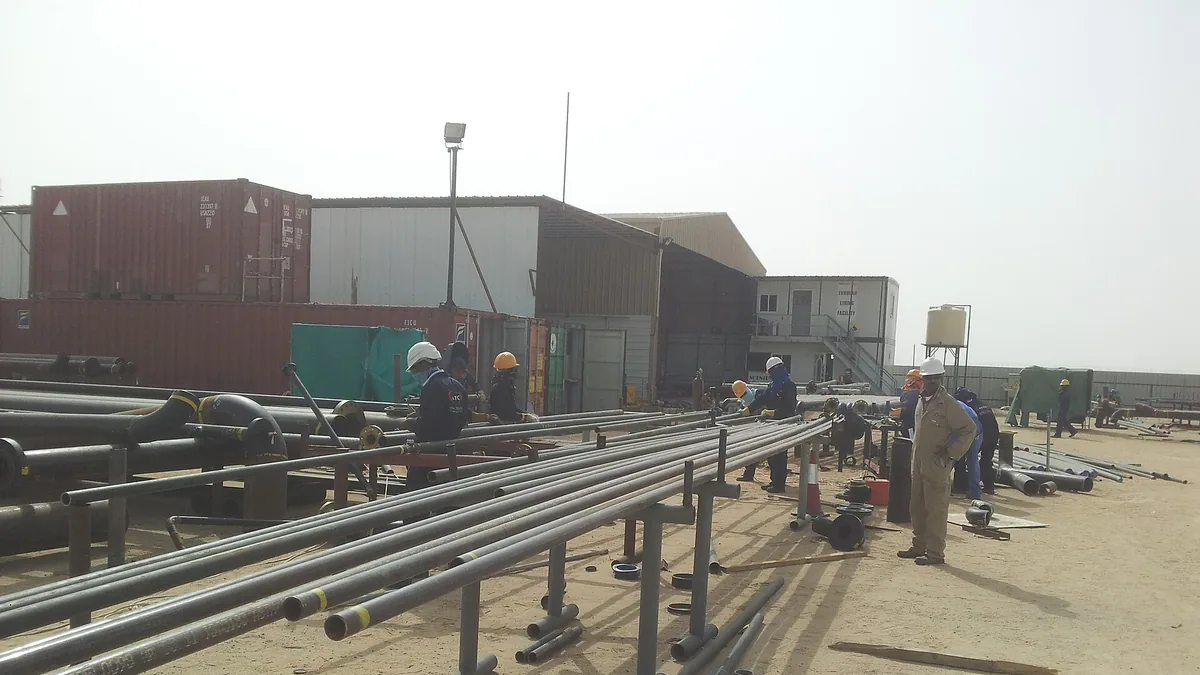

Adding hardbanding to a fabrication or welding shop is mostly a materials-handling and quality-discipline problem, not a welding-technology problem. The machines and consumables are commercially available to anyone, but profitable hardbanding requires rotating heavy drill pipe safely, controlling preheat, and producing inspection-ready documentation on every joint. Shops that treat it as “just another overlay job” in year one tend to lose money on cycle time and rework, not on weld quality alone.
This article covers the equipment, layout, and process decisions a shop owner needs to make before quoting the first hardbanding job. For background on the alloys themselves, see How Hardband Alloys Resist Abrasion Downhole and the overview in Oilfield Hardbanding: The Complete Field Guide.
What handling equipment does a hardband shop need first?#
Drill pipe is long, heavy, and awkward, and handling it badly damages both the pipe and the schedule. A standard joint of drill pipe with tool joints attached can run 30 feet or more and weigh on the order of 600 to 900 pounds depending on size and weight grade. Unlike structural steel, it cannot be safely or efficiently processed on tables and rolling benches alone: it has to be supported along its length, rotated about its axis, and moved between stations without gouging the pipe body.
The handling package for a hardband shop typically includes:
- Overhead crane or heavy forklift with rated capacity for bundles, plus slings or pipe hooks rated for round stock. Chain slings are generally avoided on finished pipe because they mark the body.
- Pipe rotators or turning rolls capable of supporting the tool joint end while allowing controlled rotation during welding. Idler rolls with a drive roll are the common configuration.
- Pipe stops and cradles at multiple points along the rack so the free end does not whip or sag during rotation.
- A thread protector discipline. Threads must be capped whenever the pipe is moved. A damaged connection costs more than an entire hardbanding job’s margin.
- Stiffback or pipe trailer for staging if you are processing truckload quantities, so pipe never sits on concrete on bare tool joints.
How much should a shop budget for handling versus welding?#
A practical rule is to budget for handling at the same level you budget for welding equipment. Shops that buy a top-tier welder and then move pipe with an undersized forklift and improvised dunnage almost always underestimate their cycle time by 30 to 50 percent. The welding machine is only one part of a hardband station; the handling package determines whether that station ever runs at its rated output.
What welding machines and positioners does hardbanding require?#
Hardbanding on tool joints is almost always done with an arc process, most commonly flux-cored or metal-cored wire, occasionally covered electrodes for small or field-adjacent work. Machine requirements are modest by heavy-fabrication standards, but duty cycle and control matter.
Machine requirements#
- Amperage range: A 350-amp class machine covers most hardbanding wires at production parameters. If you plan to run larger-diameter wires or higher deposition schedules, a 500-amp class machine with a 100 percent duty cycle rating at production amperage is the safer buy.
- Duty cycle: Hardbanding is a continuous process on a rotating part. A machine rated at 60 percent duty cycle at full output will throttle on long beads. Buy for 100 percent duty at your working amperage.
- Wire feeder: Must run smoothly at the low-to-mid parameter ranges typical of hardbanding wires, which are often smaller diameter than structural FCAW wires.
- Preheat equipment: Torch-based preheat with temperature indication (crayons, contact pyrometers, or IR thermometers) is the minimum. Induction preheat is faster and more repeatable if volume justifies it. For procedure specifics, see Hardbanding Welding Procedure: Preheat to Cool-Down.
Positioners and rotators#
The tool joint rotates; the torch or electrode stays fixed or traverses only for bead placement. That means your positioner is really a rotator with variable speed control, and the specification that matters is speed range, not just torque. Hardbanding beads are laid at surface speeds that vary with wire diameter and deposition rate, so you need smooth, repeatable control down to low RPM, not just a motor that can turn the pipe.
| Equipment item | Minimum spec | What actually pays off |
|---|---|---|
| Welding machine | 350 A, 60% duty | 400-500 A, 100% duty at working amps |
| Rotator/positioner | Variable speed, pipe-size range | Closed-loop speed control, quick tooling changeover |
| Preheat | Torch + temp sticks | Induction or built-up torch ring with IR verification |
| Handling | Rated forklift + slings | Overhead crane, dedicated pipe cradles |
| Consumable storage | Sealed containers | Heated holding ovens per manufacturer requirements |
| Inspection | Visual + calipers | Hardness tester, profile gauge, dye penetrant capability |
The build-versus-portability question is worth deciding early. A fixed shop rotator setup will always outproduce a portable rig per man-hour; if your customers also need in-field work, read Portable vs Shop Hardbanding Machines before committing to one approach.
What base material are tool joints made from?#
Tool joints are not generic steel. They are typically AISI 4130 to 4145 modified, quenched and tempered, with carbon equivalents high enough that hardbanding without proper preheat risks underbead cracking and heat-affected zone (HAZ) problems. The welding procedure has to be built around this material family, not adapted from structural procedures.
Key base-material realities:
- Hardness matters. The tool joint is already hardened. Excessive heat input softens the HAZ and reduces the joint’s fatigue and wear performance. Controlling heat input is a core skill, not an afterthought.
- Preheat is not optional. With the carbon equivalents involved, preheat controls cooling rate and reduces hydrogen cracking risk. Follow the qualified WPS, not rules of thumb from structural work.
- Existing deposits change everything. Re-hardbanding over old hardband is a different procedure with different acceptance criteria. Stripping, dilution control, and crack management in the old deposit are all in play. See Re-Applying Hardband Over Existing Deposits before you quote rework.
- Non-magnetic drill collars and HWDP for directional work often use different base materials entirely (stainless families), and require different consumables and procedures. This is a separate service line, covered in Non-Magnetic Hardbanding for Directional Drilling.
If you are coming from structural or general fabrication, the mental shift is this: in hardbanding, the customer cares as much about what the weld did not damage (the base joint, the threads, the HAZ) as about the deposit itself.
How should a hardband shop be laid out for throughput?#
Hardbanding is a flow operation, and the layout should enforce that flow. The classic failure is a single-bay “weld it where it lands” approach, which works for ten joints and collapses at a hundred. A functional hardband shop is organized into five zones that move pipe from receiving to release without backtracking.
A functional hardband shop has five zones:
- Receiving and identification. Pipe arrives, gets logged, gets a traveler (job ticket), thread protectors verified, and existing hardband condition photographed. This is also where you catch incoming damage that is not your problem.
- Pre-weld inspection and prep. Verify dimensions, check for existing cracking, strip or dress old deposits where required. Group pipe by procedure and alloy so you are not switching parameters mid-run.
- Preheat and welding. Rotator stations with preheat capability. Ideally two stations so one joint preheats while another welds.
- Post-weld handling and cool-down. Slow cooling per procedure, often with insulation or controlled ambient exposure. Do not let freshly welded joints sit in drafts or on cold concrete.
- Final inspection and release. Visual, dimensional, and hardness checks against acceptance criteria, then documentation and thread protector reinstallation before the pipe leaves. Use a defined checklist; see Hardbanding QA Checklist: Before the Pipe Leaves.
How much floor space does a hardbanding station need?#
Floor space rule of thumb: a single welding station with staging, preheat, and cool-down space around it consumes far more footprint than the rotator footprint itself. Plan for pipe-length clear zones (roughly 40 feet minimum per lane) and separate traffic lanes for the handling equipment.
What documentation do oilfield customers require?#
Oilfield customers do not buy welds, they buy records. Expect to be asked for a qualified welding procedure specification (WPS), procedure qualification records (PQRs), welder qualification records, material traceability for consumables, and per-joint documentation showing parameters, preheat verification, and inspection results.
The documentation burden is a genuine cost line. Before quoting, decide:
- Which procedures you will qualify in-house versus adopt from consumable manufacturer guidance.
- How you will record preheat, interpass, and cool-down data per joint (paper travelers work; digital travelers scale better).
- What inspection criteria you will commit to, and whether you can meet them with in-house capability. The criteria themselves are covered in Hardbanding Inspection and Acceptance Criteria.
What mistakes do new hardband shops make in year one?#
Most first-year failures in new hardband shops follow predictable patterns. Knowing them in advance is cheaper than learning them. The list below covers the quoting, alloy-selection, and equipment-redundancy errors that repeatedly cost new shops money.
- Quoting by weld time only. The quote covers handling, preheat, cool-down, inspection, and paperwork. If your estimate is built from arc-on time, you will lose money on the first truckload.
- Underestimating rework over existing deposits. Old hardband that is cracked, spalled, or off-position turns a simple overlay job into a strip-and-rebuild job. Inspect and classify incoming pipe before committing to a price.
- No crack policy. Some hardband alloys are designed to deposit with fine, controlled checking; others must be crack-free. Confusing the two, or not knowing which alloy you are running, leads to rejected loads. See Crack-Free Hardband Alloys: What Actually Works and Casing-Friendly vs Abrasive Hardband Alloys for alloy selection.
- Ignoring alloy-to-application fit. Running an aggressive abrasive alloy on pipe destined for casing-rotating wells will win you a customer complaint and lose you the account.
- One positioner, no redundancy. When the rotator drive fails, the whole line stops. A second station or a manual-rotation backup keeps the schedule alive.
- Skipping thread protection. One set of damaged threads on a premium connection can erase the margin on a full pallet of hardbanding work.
- Treating cool-down as dead time. It is not. Joints that cool too fast can crack. Build slow-cool into the floor plan and the quote.
How should hardbanding work be priced?#
Hardbanding pricing is usually quoted per tool joint, and the shop’s real margin lives in throughput and rework rate, not in the wire cost. Consumables are a visible but small fraction of cost; labor, handling, preheat energy, inspection time, and documentation dominate. When evaluating whether a job is worth taking, model the full cycle: minutes of handling per joint, minutes of arc time, minutes of preheat and cool-down, minutes of inspection and paperwork. Then multiply by the joint count and compare against your real labor and overhead rates.
For customers weighing the cost, the downtime math is on their side: The Cost of Skipping Hardbanding: Downtime Math lays out the argument you can make in your own quotes.
Key takeaways#
- Hardbanding is a materials-handling and process-discipline business. Budget handling gear at the same level as welding equipment.
- Buy machines for 100 percent duty cycle at working amperage, and buy rotators for smooth low-speed control, not just torque.
- Tool joints are 4130-4145 Q&T steel: preheat and heat-input control are non-negotiable, and the HAZ is part of the deliverable.
- Lay the shop out as a five-zone flow: receiving, prep, preheat/weld, cool-down, inspection. Single-bay setups do not scale.
- Documentation is the product as much as the deposit. Build the quality system before the first job, not after the first rejection.
- Most first-year losses come from underquoting cycle time, misclassifying rework over old deposits, and not knowing which alloy system is on the wire.
- hardbanding
- AISI 4145 steel
- flux-cored arc welding
- drill pipe
- welding procedure specification
- heat-affected zone
- heavyweight drill pipe